Power · 13 min read
Batteries for Off-Grid: Lead-Acid vs Lithium, and How to Size a Bank
Understand depth of discharge, cycle life, temperature and cost, then size a battery bank that actually matches your loads — with runtime math you can check.
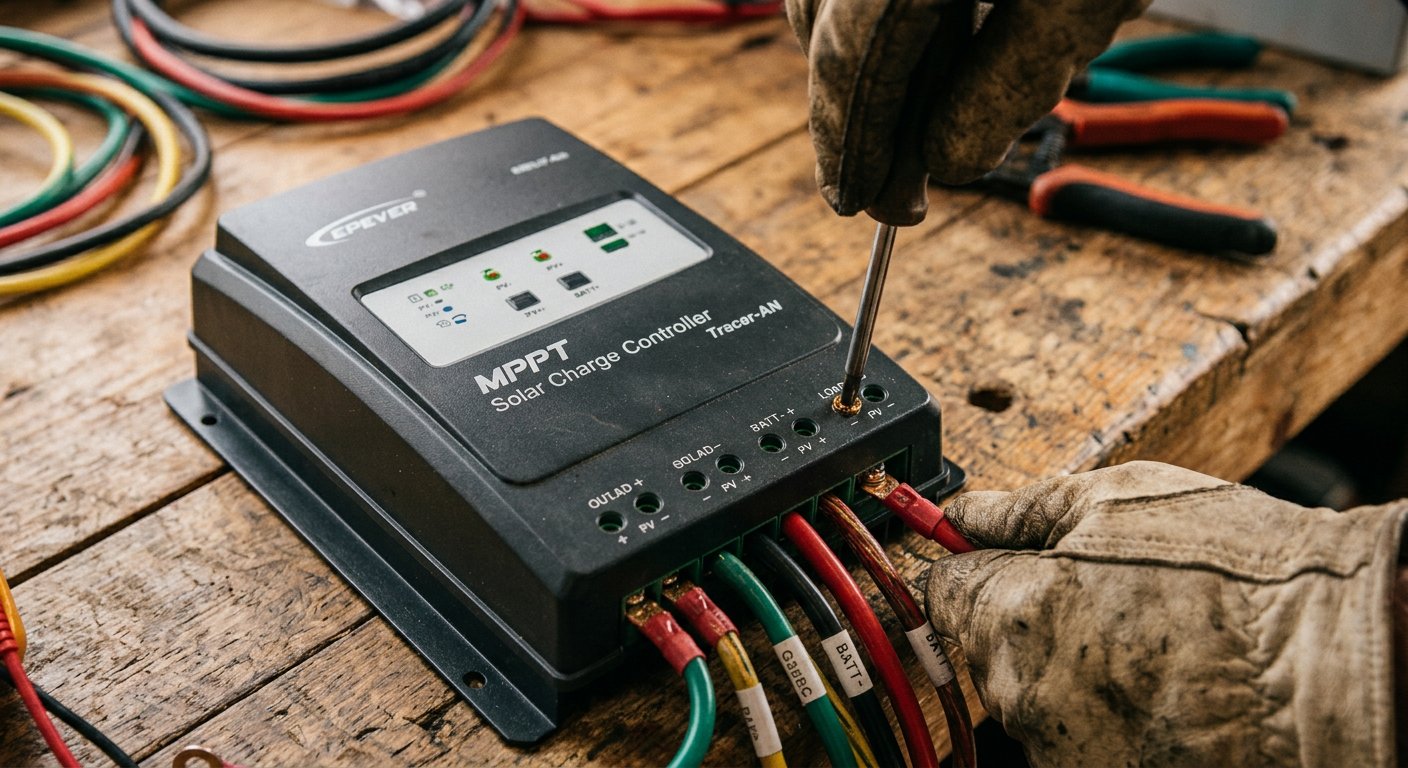
The battery bank is the most expensive, most misunderstood part of an off-grid power system — and the part most likely to be replaced too soon. Choose the right chemistry and size it honestly, and a good bank can last a decade or more. Get it wrong and you'll be replacing it in two years.
Lead-acid vs lithium: the real trade-off
| Lead-acid (flooded / AGM) | LiFePO₄ (lithium iron phosphate) | |
|---|---|---|
| Usable capacity | ~50% DoD | ~85–90% DoD |
| Cycle life | 300–1,200 cycles (depth-dependent) | 3,000–6,000+ cycles |
| Upfront cost | Lower | Higher, but lower cost per usable kWh over life |
| Temperature | Capacity drops sharply in cold | Far less affected; most have low-temp protection |
| Maintenance | Flooded needs watering & equalising | Essentially none |
For almost all new off-grid builds, LiFePO₄ wins on lifetime cost and hassle. Lead-acid still has a place where budget is tight up front, or where extreme cold or fire regulations favour it — but understand you'll use half the nameplate capacity and replace it sooner.
How to size a bank
You're sizing for two things: how much energy you use (watt-hours), and how many days you need to ride out without sun. The formula, in plain terms:
Usable energy (Wh) = Ah × volts × DoD × 0.9
Required Ah = (daily Wh × autonomy days) ÷ (volts × DoD × 0.9)
The 0.9 is inverter/wiring efficiency; DoD is 0.5 for lead-acid, 0.85 for lithium. The battery & runtime calculator does both directions — bank-to-runtime and load-to-bank — so you can check your own figures.
Reading a battery's real capacity
- Amp-hours (Ah) always come with a voltage. A "100 Ah" 12 V battery stores 1,200 Wh; a "100 Ah" 48 V battery stores 4,800 Wh. Always compare in watt-hours.
- Peukert effect (lead-acid): the faster you discharge, the less capacity you actually get. Lithium is barely affected.
- Series vs parallel: series raises voltage (keep Ah the same); parallel raises capacity (keep voltage the same). Mixing old and new batteries in a bank degrades all of them — replace as a set.
Why batteries die early (and how to avoid it)
- Chronic under-charging — the #1 killer of lead-acid. Ensure your array can actually recharge the bank on a cloudy day.
- Over-discharging — a low-voltage disconnect protects the bank.
- Heat — batteries last longest cool and dry; don't put them in a hot shed.
- Cold charging — charging lithium below ~0 °C destroys it; buy cells with low-temperature protection.
- Unbalanced cells — a battery management system (BMS) is essential, not optional.
Safety
A battery bank stores enormous energy. Short circuits can cause explosions, fire and burns; battery electrolyte and lithium thermal runaway are serious hazards. Fuse every positive cable close to the terminal, use correct cable sizing, and have a licensed electrician commission any large or mains-connected bank.